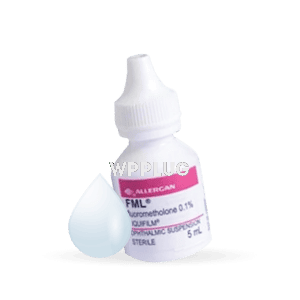
FML Forte
| Product dosage: 5ml | |||
|---|---|---|---|
| Package (num) | Per flacon | Price | Buy |
| 2 | $21.50 | $43.00 (0%) | 🛒 Add to cart |
| 3 | $19.67 | $64.50 $59.00 (9%) | 🛒 Add to cart |
| 4 | $18.50 | $86.00 $74.00 (14%) | 🛒 Add to cart |
| 5 | $17.80 | $107.50 $89.00 (17%) | 🛒 Add to cart |
| 6 | $17.50 | $129.00 $105.00 (19%) | 🛒 Add to cart |
| 7 | $17.14 | $150.50 $120.00 (20%) | 🛒 Add to cart |
| 8 | $17.00 | $172.00 $136.00 (21%) | 🛒 Add to cart |
| 9 | $16.78 | $193.50 $151.00 (22%) | 🛒 Add to cart |
| 10 | $16.60
Best per flacon | $215.00 $166.00 (23%) | 🛒 Add to cart |
FML Forte: Potent Ophthalmic Relief for Post-Surgical Inflammation
FML Forte (fluorometholone ophthalmic suspension) 0.25% is a high-potency topical corticosteroid formulated for the management of significant inflammatory conditions of the palpebral and bulbar conjunctiva, cornea, and anterior segment of the globe. It is specifically indicated for steroid-responsive inflammatory conditions where a more robust corticosteroid effect is warranted than that provided by standard 0.1% formulations. Its enhanced efficacy makes it a cornerstone in post-operative ophthalmic care, particularly following cataract extraction and other intraocular surgeries, to suppress inflammation and prevent complications that can compromise visual outcomes. This suspension is designed for precise therapeutic intervention under expert supervision.
Features
- Active Ingredient: Fluorometholone 0.25% (as acetate).
- Dosage Form: Sterile, preserved ophthalmic suspension.
- Presentation: Typically supplied in a 5 mL or 10 mL plastic dropper bottle.
- Mechanism of Action: A synthetic difluorinated corticosteroid that inhibits the inflammatory response to inciting agents, potentially by inducing phospholipase A2 inhibitory proteins.
- Excipients: Includes suspending agents (e.g., polyvinyl alcohol), preservatives (e.g., benzalkonium chloride), and buffers to maintain stability and comfort.
- pH: Adjusted to approximate the pH of tears to minimize stinging upon instillation.
Benefits
- Delivers superior anti-inflammatory potency compared to standard 0.1% steroid drops, providing more effective control over severe ocular inflammation.
- Significantly reduces patient discomfort, pain, photophobia, and blurred vision associated with intense inflammatory responses.
- Accelerates the resolution of post-surgical inflammation, promoting a more rapid and comfortable recovery process.
- Helps prevent the formation of sight-threatening complications such as synechiae and cystoid macular edema by adequately suppressing the immune response.
- Offers a favorable balance of high clinical efficacy with a relatively lower propensity for raising intraocular pressure (IOP) compared to some other potent corticosteroids like dexamethasone or prednisolone.
Common use
FML Forte is primarily prescribed for short-term treatment of steroid-responsive inflammatory conditions of the eye that require a potent corticosteroid effect. Its most frequent application is in the post-operative management of patients who have undergone ocular surgery, such as cataract extraction, glaucoma filtering surgery, or corneal transplant, where controlling inflammation is critical for surgical success. It is also used in cases of severe allergic conjunctivitis, vernal keratoconjunctivitis, episcleritis, and anterior uveitis (iritis and iridocyclitis). Its use is typically reserved for situations where the risk of significant inflammation outweighs the potential risks of potent steroid therapy.
Dosage and direction
The dosage of FML Forte is highly individualized and must be determined by an ophthalmologist based on the severity of the condition. One drop is instilled into the conjunctival sac of the affected eye(s). For severe inflammation, the typical initial dosing is one drop two to four times daily. Dosage may be tapered based on clinical response. It is critical to shake the bottle well before each use to ensure a uniform suspension. To prevent contamination, patients should be instructed to avoid touching the dropper tip to any surface, including the eye or fingers. If more than one topical ophthalmic medication is being used, they should be administered at least 5 to 10 minutes apart, with ocular suspensions like FML Forte typically administered last.
Precautions
- Intraocular Pressure (IOP): Corticosteroids can cause a rise in IOP in susceptible individuals, which may be reversible upon discontinuation or may lead to glaucomatous damage and optic nerve atrophy. IOP should be monitored frequently during treatment.
- Cataract Formation: Prolonged use may cause posterior subcapsular cataract formation.
- Infection: Corticosteroids may mask, enhance, or activate ocular infections. Fungal infections of the cornea are particularly prone to develop coincidentally with long-term applications of steroids. A patient with a history of herpes simplex keratitis should use this drug with extreme caution due to the risk of corneal perforation.
- Perforation: Use in eyes with thin corneas (e.g., after disease or surgery) may lead to perforation.
- Pregnancy/Lactation: Use during pregnancy or by nursing mothers only if the potential benefit justifies the potential risk to the fetus or infant.
- Contact Lenses: Soft contact lenses should not be worn during the use of this medication, as the preservative (benzalkonium chloride) can be absorbed by the lens material.
Contraindications
FML Forte is contraindicated in patients with:
- Most viral diseases of the cornea and conjunctiva, including epithelial herpes simplex keratitis (dendritic keratitis), vaccinia, and varicella.
- Mycobacterial or fungal infections of the eye.
- Hypersensitivity to any component of the formulation.
- Acute, purulent, untreated bacterial infections.
Possible side effect
While not all patients experience side effects, the following have been reported:
- Common: Transient stinging or burning upon instillation; blurred vision.
- Less Common: Elevated intraocular pressure (steroid responders); ocular irritation, discomfort, or pain; foreign body sensation; itching; conjunctival hyperemia (redness); punctate keratitis; headache.
- Rare but Serious: Glaucoma; optic nerve damage; posterior subcapsular cataract formation; perforation of the globe; secondary ocular infections (bacterial, fungal, or viral); delayed wound healing; mydriasis; ptosis.
Drug interaction
- Other Topical Ophthalmic Agents: No formal drug interaction studies have been conducted. When using multiple eye drops, administer them at least 5-10 minutes apart to prevent wash-out and allow for adequate absorption.
- Systemic Effects: While significant systemic absorption from topical ophthalmic use is uncommon, potential interactions with systemic drugs metabolized by CYP 3A4 are theoretically possible but highly unlikely at recommended doses.
Missed dose
If a dose is missed, it should be instilled as soon as possible. However, if it is almost time for the next scheduled dose, the missed dose should be skipped, and the regular dosing schedule resumed. The patient should not instill a double dose to make up for the missed one.
Overdose
Topical ocular overdose is unlikely to cause life-threatening systemic effects. It may be manifested as an increase in the known local side effects, such as severe ocular discomfort, redness, or blurred vision. The eyes should be rinsed thoroughly with warm water. Symptomatic and supportive care should be provided. In case of accidental ingestion, seek medical attention or contact a Poison Control Center immediately.
Storage
- Store at controlled room temperature, 15°-30°C (59°-86°F).
- Protect from light and freezing.
- Keep the bottle tightly closed when not in use.
- Discard the bottle and any remaining medication one month after first opening it to prevent contamination and loss of potency. Write the date of opening on the bottle label.
Disclaimer
This information is for educational and informational purposes only and does not constitute medical advice. It is not a substitute for professional medical advice, diagnosis, or treatment. Always seek the advice of your ophthalmologist or other qualified health provider with any questions you may have regarding a medical condition or medication. Never disregard professional medical advice or delay in seeking it because of something you have read here. The prescribing information provided here may not be comprehensive or up-to-date.
Reviews
- “As a corneal specialist, FML Forte is my go-to for managing significant post-PRK inflammation. The potency is excellent, and I find the IOP spike profile more favorable than with prednisolone in many of my patients.” – Dr. A. Sharma, MD
- “We routinely use FML Forte in our cataract surgery post-op regimen for patients with a history of uveitis or those who present with a particularly aggressive inflammatory response. It provides the control we need.” – Surgical Center, Nurse Practitioner
- “Patient tolerance is generally good. The initial stinging is minimal compared to some other steroid drops, which improves compliance. The key, as with all steroids, is vigilant monitoring of pressure.” – Dr. L. Chen, OD